Chapter 3 · Part 2
The Caucus-Race
Design a race with no starting line, no finish line, and no loser. Explain the rules aloud.
- I notice…
- I predict…
- My reason is…
adjourn
Stop a meeting for now.
energetic
Full of action.
panting
Breathing hard.
Listen
Listen for every rule of the Caucus-race. Then explain why it is impossible to decide a winner normally.
Reading mode
Read the story
Focus sentences
Read the highlighted sentences twice. They connect the key vocabulary to the most important moments in this part.
The Mouse did not notice this question, but hurriedly went on, “‘—found it advisable to go with Edgar Atheling to meet William and offer him the crown. William’s conduct at first was moderate. But the insolence of his Normans—’ How are you getting on now, my dear?” it continued, turning to Alice as it spoke.
“As wet as ever,” said Alice in a melancholy tone: “it doesn’t seem to dry me at all.”
“In that case,” said the Dodo solemnly, rising to its feet, “I move that the meeting adjourn, for the immediate adoption of more energetic remedies—”
“Speak English!” said the Eaglet. “I don’t know the meaning of half those long words, and, what’s more, I don’t believe you do either!” And the Eaglet bent down its head to hide a smile: some of the other birds tittered audibly.
“What I was going to say,” said the Dodo in an offended tone, “was, that the best thing to get us dry would be a Caucus-race.”
“What is a Caucus-race?” said Alice; not that she wanted much to know, but the Dodo had paused as if it thought that somebody ought to speak, and no one else seemed inclined to say anything.
“Why,” said the Dodo, “the best way to explain it is to do it.” (And, as you might like to try the thing yourself, some winter day, I will tell you how the Dodo managed it. )
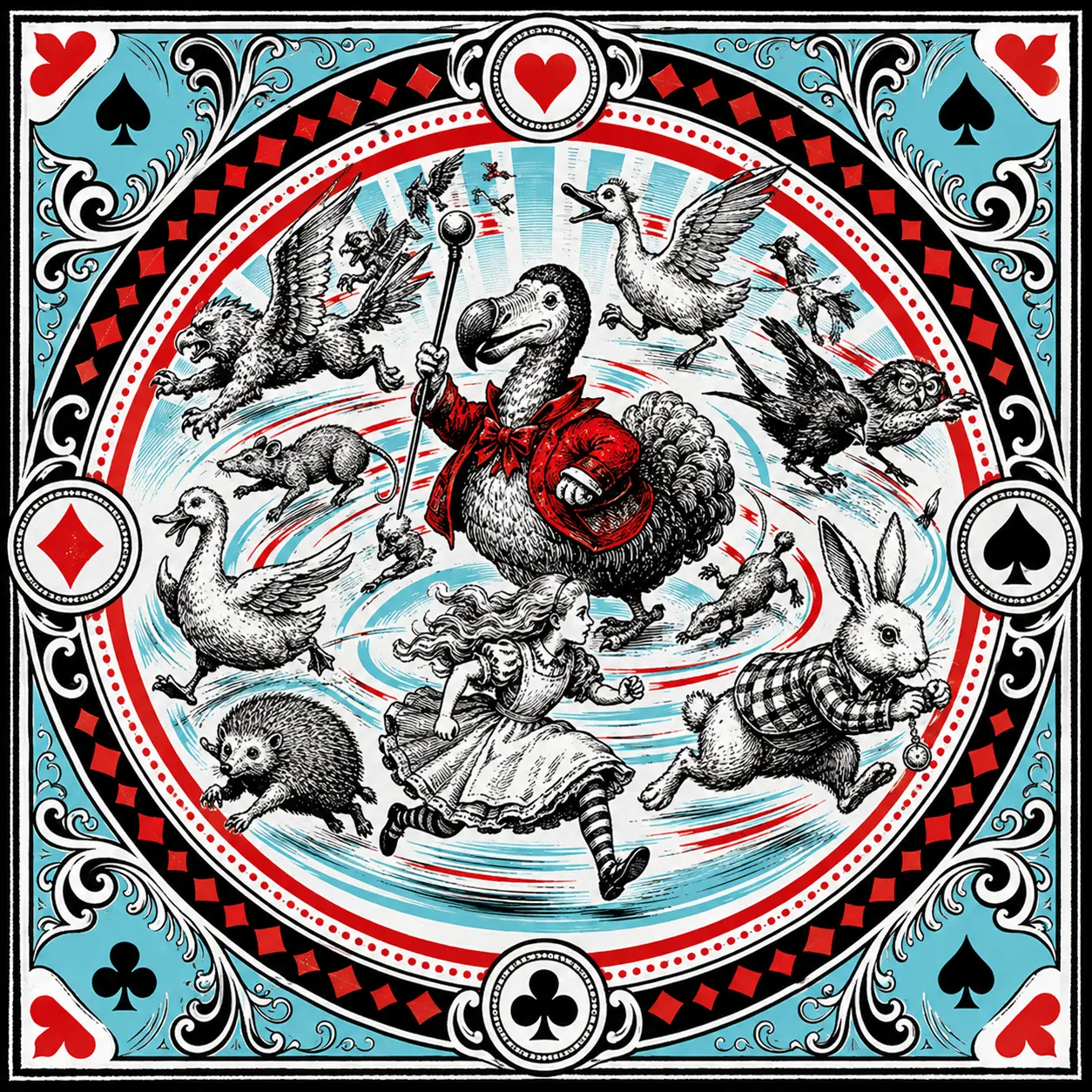
First it marked out a race-course, in a sort of circle, (“the exact shape doesn’t matter,” it said,) and then all the party were placed along the course, here and there. There was no “One, two, three, and away,” but they began running when they liked, and left off when they liked, so that it was not easy to know when the race was over. However, when they had been running half an hour or so, and were quite dry again, the Dodo suddenly called out “The race is over!” and they all crowded round it, panting, and asking, “But who has won?”
This question the Dodo could not answer without a great deal of thought, and it sat for a long time with one finger pressed upon its forehead (the position in which you usually see Shakespeare, in the pictures of him), while the rest waited in silence. At last the Dodo said, “Everybody has won, and all must have prizes.”
“But who is to give the prizes?” quite a chorus of voices asked.
“Why, she, of course,” said the Dodo, pointing to Alice with one finger; and the whole party at once crowded round her, calling out in a confused way, “Prizes! Prizes!”
What is unusual about the start of the race?
Who does the Dodo decide has won?
Convince the class that a competition where everybody wins can still be a real competition.
- It still counts because…
- Winning could mean…
- The strange part is…
Finished this part?
Mark it complete to track your progress through the chapter.